
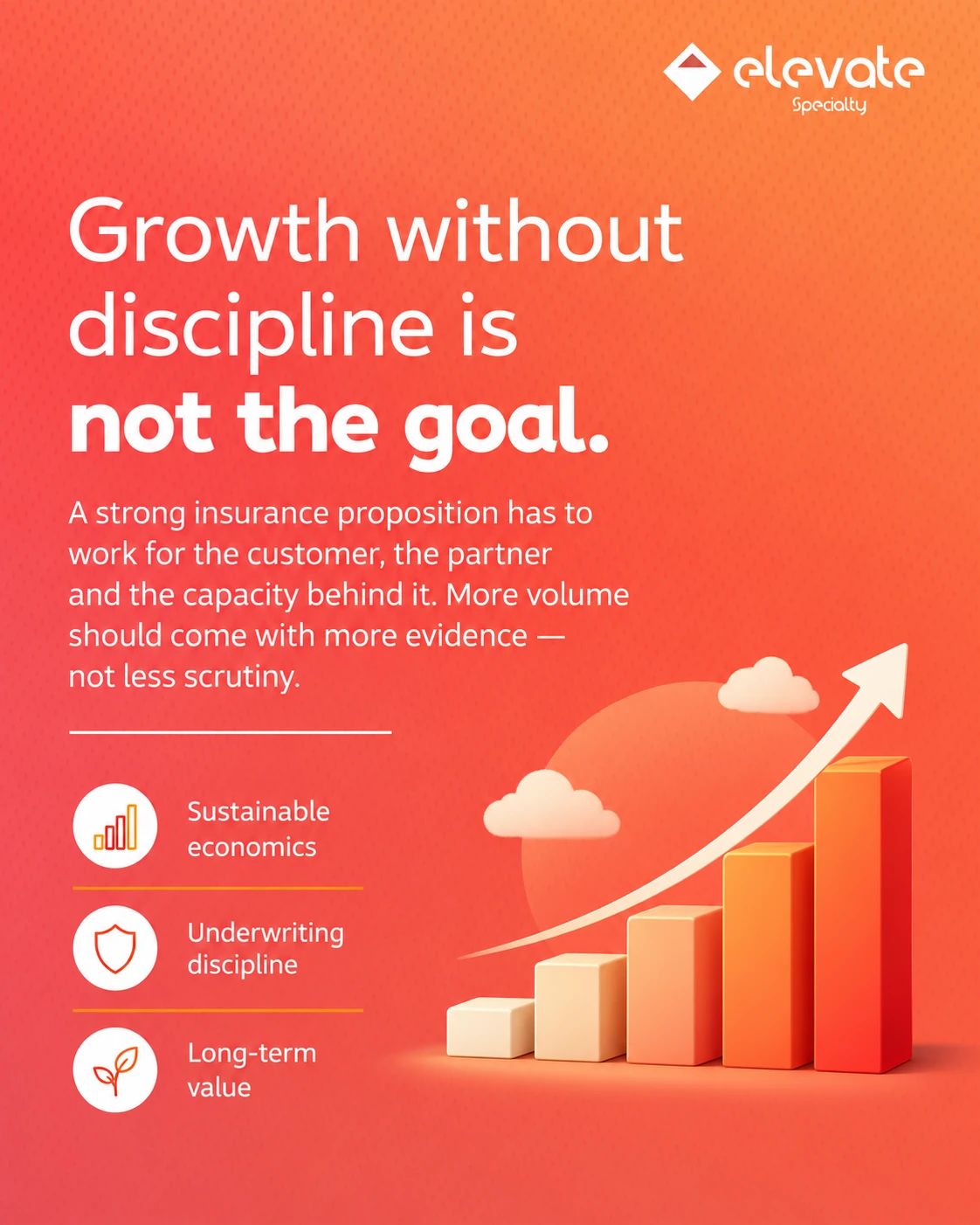
Premium growth is easy to put in a headline. The quality of that growth takes more work to explain.
For an insurance partnership, the important questions come after the volume: is the risk understood, is the service properly resourced, are the economics sustainable, and is the customer receiving worthwhile protection?
Those questions belong together. A proposition that looks attractive to one participant while relying on weak outcomes or unrealistic assumptions elsewhere is not a strong foundation for a lasting relationship.
At Elevate, our approach is built around disciplined underwriting and sustainable partnership economics. Growth should strengthen the proposition—not outpace the operation or obscure what is happening underneath it.
Start with the whole proposition.
An insurance programme has to fund more than distribution.
Expected claims and legal costs, claims handling, assistance, specialist delivery, insurer and reinsurance arrangements, and programme management all have a place in the economics. The partner’s remuneration needs to be understood alongside them, with Insurance Premium Tax shown separately from premium.
Clarity matters because different numbers describe different things. Premium managed is not Elevate revenue. Premium growth is not proof of underwriting profitability. A forecast is not an achieved result.
Equally, corporate profitability and underwriting performance are not interchangeable. A sound assessment considers the operating business, the insured risk and the value offered to the customer.
Our partnership approach starts with that complete picture, rather than asking a headline commission or premium figure to stand in for it.
Claims information should influence underwriting decisions.
Discipline is not a one-off exercise completed when a scheme is priced. It is the willingness to examine experience and act when assumptions need to change.
The information collected through a claim or assistance request can help reveal where frequency differs, which issues progress to formal action, what drives severity and reserve movement, and where customer friction recurs.
Our operating model connects that case information with underwriting questions and management actions. Selection, wording and price may need review by segment. An intervention or escalation route may need to change. Cost controls or reserving assumptions may need attention. Repeated service problems may require a different process.
Efficiency should remove waste, not useful help.
There is an important difference between reducing unnecessary work and making it harder for a customer to obtain support.
Repeated information gathering, unclear handoffs and activity that does not move a case forward are reasonable targets for improvement. Appropriate advice, professional judgement and necessary legal action are not simply costs to eliminate.
Active Assistance fits into that distinction. It is designed to explore practical intervention where appropriate, with customer consent, and to verify the result. It is not a substitute for funded legal action where that is the right authorised route.
Nor should early resolution be assumed to save money in every case. Its effect on outcomes, legal costs and the overall service needs to be examined through experience.
Sustainable economics should be supported by a service that does the right work at the right stage—not one that confuses lower activity with better performance.
Resource the business that the programme creates.
Growth brings operational consequences.
More notifications may create more open cases, advice calls, assistance hours and demands on specialist providers. A different mix of business can change the workload even when headline volumes remain similar.
That is why capacity planning belongs in the commercial discussion. The service needs trained people, supervision, technical support, supplier availability and appropriate recovery arrangements. Pricing and launch plans should recognise the work required to deliver the proposition.
At Elevate, the principle is to connect customer demand, underwriting assumptions and service readiness, so that growth is considered as an operating commitment as well as a sales opportunity.
Align the structure with the partner’s appetite.
Different partners want different relationships with risk.
Some want an insured programme with connected delivery. Others want claims and assistance services around an existing insurance arrangement. Some may wish to consider agreed participation in underwriting economics.
These options should be assessed on their own merits. Participation in risk is not simply another income stream: the capital, loss exposure, contractual responsibilities and profit mechanics need to be understood.
Our model allows the conversation to begin with the partner’s capability and objectives, then establish the appropriate scope and approvals. The economics should remain understandable as the relationship develops.
Make review a decision-making process.
The discipline becomes visible in the account review.
When costs rise, outcomes are unclear or service measures deteriorate, the response should be specific. Understand the affected cases. Identify the cause. Agree an intervention, an owner and a date. Then check whether the change improved the position.
That creates a more useful conversation than celebrating growth in isolation or presenting every variance as a temporary inconvenience.
We want partnerships in which customer value, underwriting performance and commercial returns can be discussed openly. Each is part of the case for continuing, improving or expanding the programme.
Growth remains an ambition. But growth earns its place by supporting a proposition that can keep delivering.