A customer worried about a change to their job does not begin by thinking about legal-expenses cover. They think about their income, their household and what they should do next.
Someone facing a difficult consumer or home-related dispute has a similarly practical concern. They want the problem understood. They want to know their options. They may need help taking the next step, not simply a description of the law.
For home and family Legal Expenses Insurance, that is the experience the proposition needs to address.
At Elevate, we believe legal cover should provide a visible route to help: a guided way in, access to specialist advice, practical assistance within the agreed service, and a route to formal legal support where appropriate.
The objective is not to turn every concern into a claim for litigation funding. It is to help with the problem behind the claim.
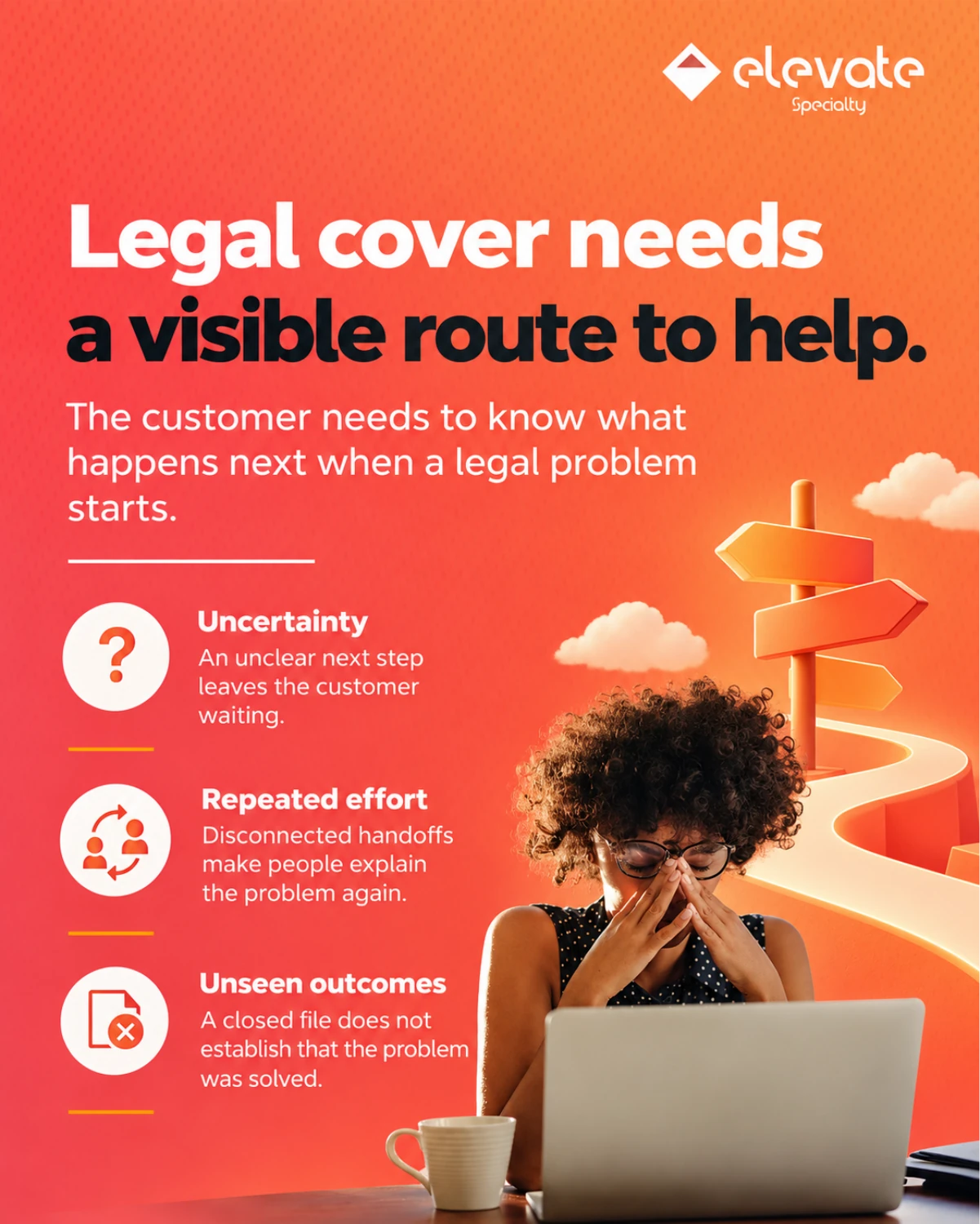
Legal cover needs a visible route to help.
There are three weaknesses a well-designed journey should address: uncertainty, repeated effort and unseen outcomes.
Uncertainty begins when a customer does not know where to go or what will happen after making contact. Repeated effort arises when disconnected handoffs require them to explain the issue again. Unseen outcomes arise when the file is closed without establishing what happened to the underlying problem.
These are service-design questions, not simply questions about the wording.
Our family legal journey starts by understanding the issue, key dates, support needs and the result the customer wants. The customer can then provide relevant evidence, access advice and agree an appropriate next action.
Digital access should make those steps easier, while retaining a human route to support. A customer’s contact preferences, circumstances and need for help with documents or digital tasks should influence the journey.
The aim is that the customer can understand the next step throughout the case—not merely discover which team has it.
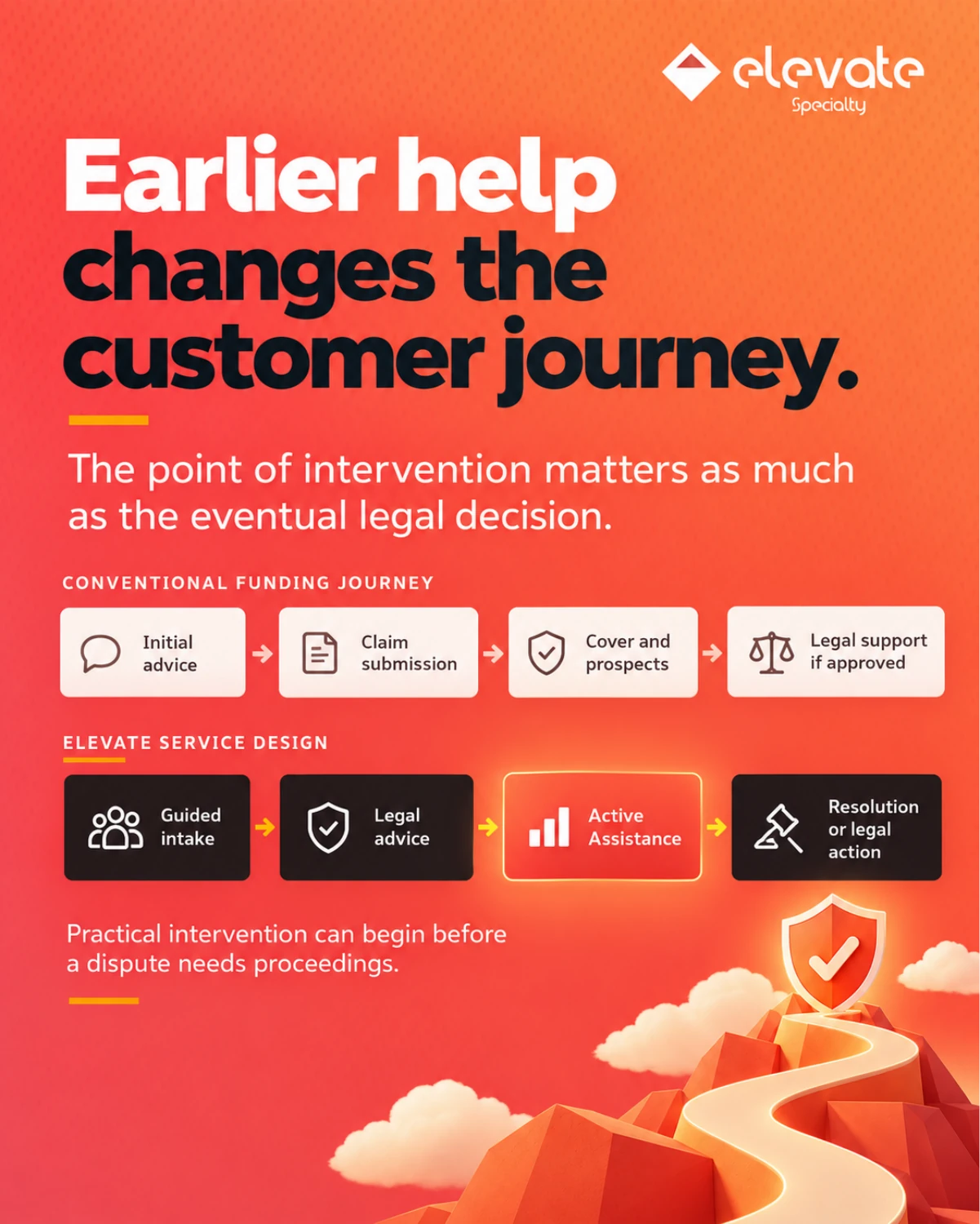
Earlier help changes the journey.
An insurance funding decision and a practical response to a legal problem perform different jobs.
In a conventional funding journey, the sequence may be initial advice, claim submission, assessment of cover and prospects, and legal support if approved. Those assessments have an important purpose. But the service can also ask whether useful intervention is available before proceedings become the appropriate route.
Elevate’s service design connects guided intake, legal advice, Active Assistance and either resolution or appropriate legal action. Cover and the agreed service scope still apply.
This is not about bypassing eligibility or promising representation for every dispute. It is about asking a broader question earlier: what can reasonably be done to help this customer with the problem they have brought to us?
The point of intervention matters alongside the eventual legal decision. A conversation about a proposed change may call for a different response from a dispute that has already reached the point of proceedings.
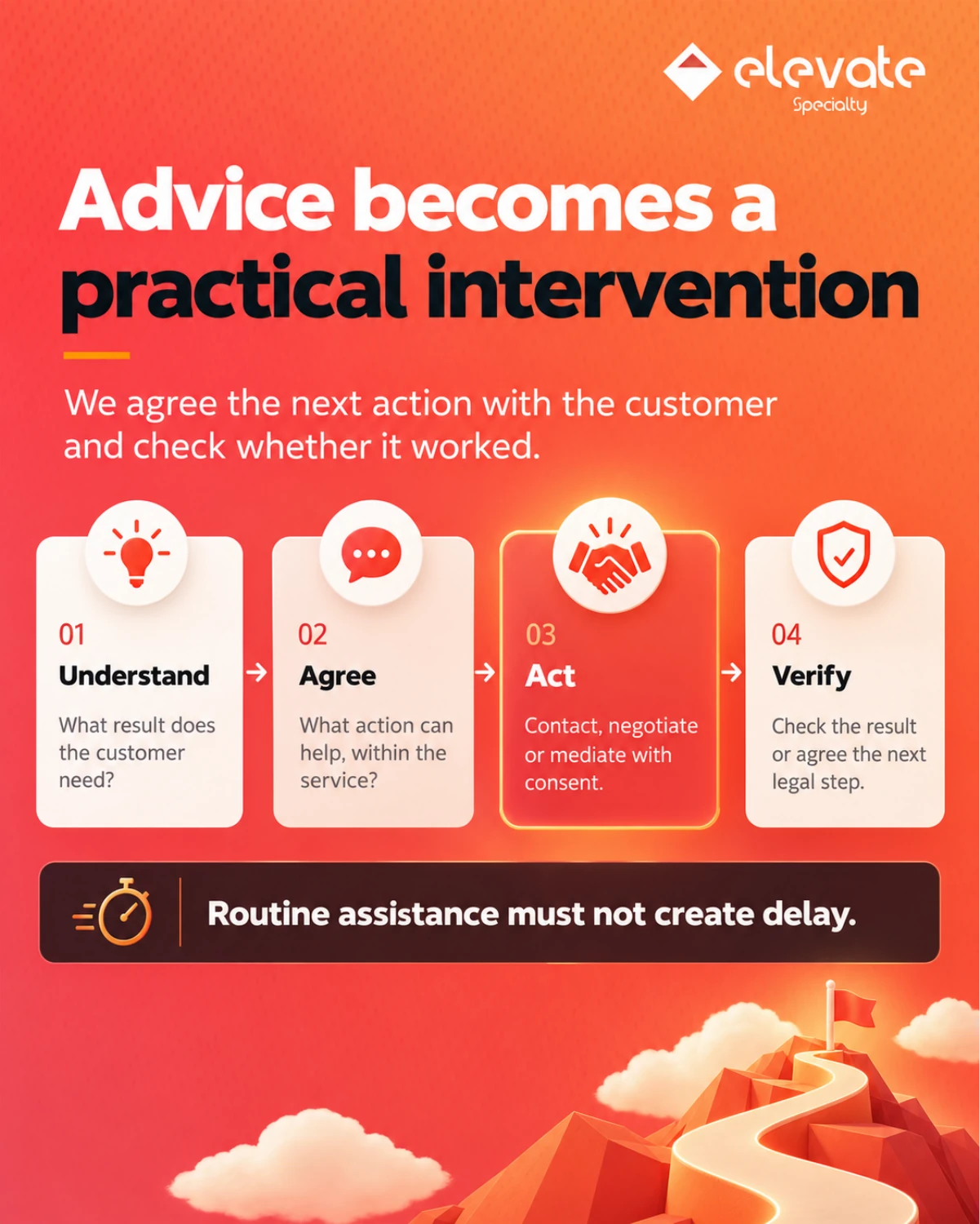
Advice becomes a practical intervention.
Active Assistance is designed to connect advice to an agreed action—and then check the result.
First, understand. What has happened, what matters to the customer and what outcome are they seeking? A legally valid option is not automatically the option that best addresses their objective.
Then, agree. Establish what action may help within the service, explain it and obtain the customer’s consent. The customer remains involved in decisions about their own situation.
Next, act. Depending on the matter and agreed scope, that can mean contacting another party, negotiating or mediating. The action should have a clear purpose rather than becoming another administrative stage.
Finally, verify. Did the agreement take effect? Did it address the concern? Is another step needed? Has the matter reached the point where specialist assessment of formal legal support is required?
That final step is important. Giving advice, sending correspondence and securing a practical result are not the same thing. A service should be able to explain which has occurred.
Start with what the customer wants to preserve.
Consider the illustrative employment scenario in our family legal journey—not a reported customer case.
An employee faces a proposed role change that would reduce gross monthly salary from £3,000 to £2,700. Their objective is to remain employed and maintain their existing pay.
That objective shapes the response. With consent, an adviser contacts the employer to discuss the proposal, seek time to respond and explore suitable alternative duties. The customer decides whether to accept any proposed agreement.
In the illustration, an alternative role is agreed at the existing £3,000 salary. The service then checks that the role is in place and that the first payslip reflects the agreement.
The point is not that every employment dispute can be resolved in this way. It is that the desired outcome should influence the intervention, and the intervention should be followed through.
The customer did not ask for a completed process. They wanted to preserve something important in their life.
Early assistance must not become another barrier.
A resolution-first approach is not a rule that every matter must pass through negotiation or mediation before receiving legal attention.
Urgent legal action moves on its own timetable. Routine assistance must not create delay. Human assessment determines the appropriate route, and urgent matters should go directly to the relevant specialist.
Where the issue remains unresolved, formal support requires the appropriate legal and cover assessment, including prospects and proportionality where applicable. Representation follows when authorised.
If funded proceedings are unavailable, the customer still needs a clear explanation and an appropriate next step within the available service. A decision should clarify the position, not leave the customer trying to interpret an unexplained endpoint.
Active Assistance and insured litigation funding are complementary parts of the proposition. Neither should be confused with an unlimited promise of help or a guaranteed outcome.
A closed file is not the same as a resolved problem.
Our proposed case-management journey keeps advice, consent, instructions and updates together, with an accountable owner and a visible next action.
At resolution, the service checks what actually happened. In the employment illustration, that includes customer confirmation and the first payslip. If the agreement breaks down, the customer has a route back for help.
This distinction also matters to the insurer or distributor. Reporting should explain whether assistance was delivered, whether an intervention worked, why legal action was appropriate and how the customer experienced the service.
A recorded resolution should mean something different from a declined funding request, a referral or an unknown outcome. Without that distinction, an impressive activity report can still leave the partner unable to see the value delivered.
A stronger home legal proposition starts with a better question.
For partners reviewing home and family legal cover, the question should not stop at the insured events or the limit available for proceedings.
Ask when practical help begins. Ask who owns the next step after a referral. Ask how the customer’s objective shapes the response. Ask how the provider knows whether the problem was resolved.
Those questions bring the service behind the policy into view.
That is the proposition Elevate is designing around: earlier help where appropriate, practical action with consent, clear legal assessment and outcomes that are checked rather than assumed.
Home legal should help people navigate the problem, not give them another process to navigate.
Insurance that works.
Explore the campaign