
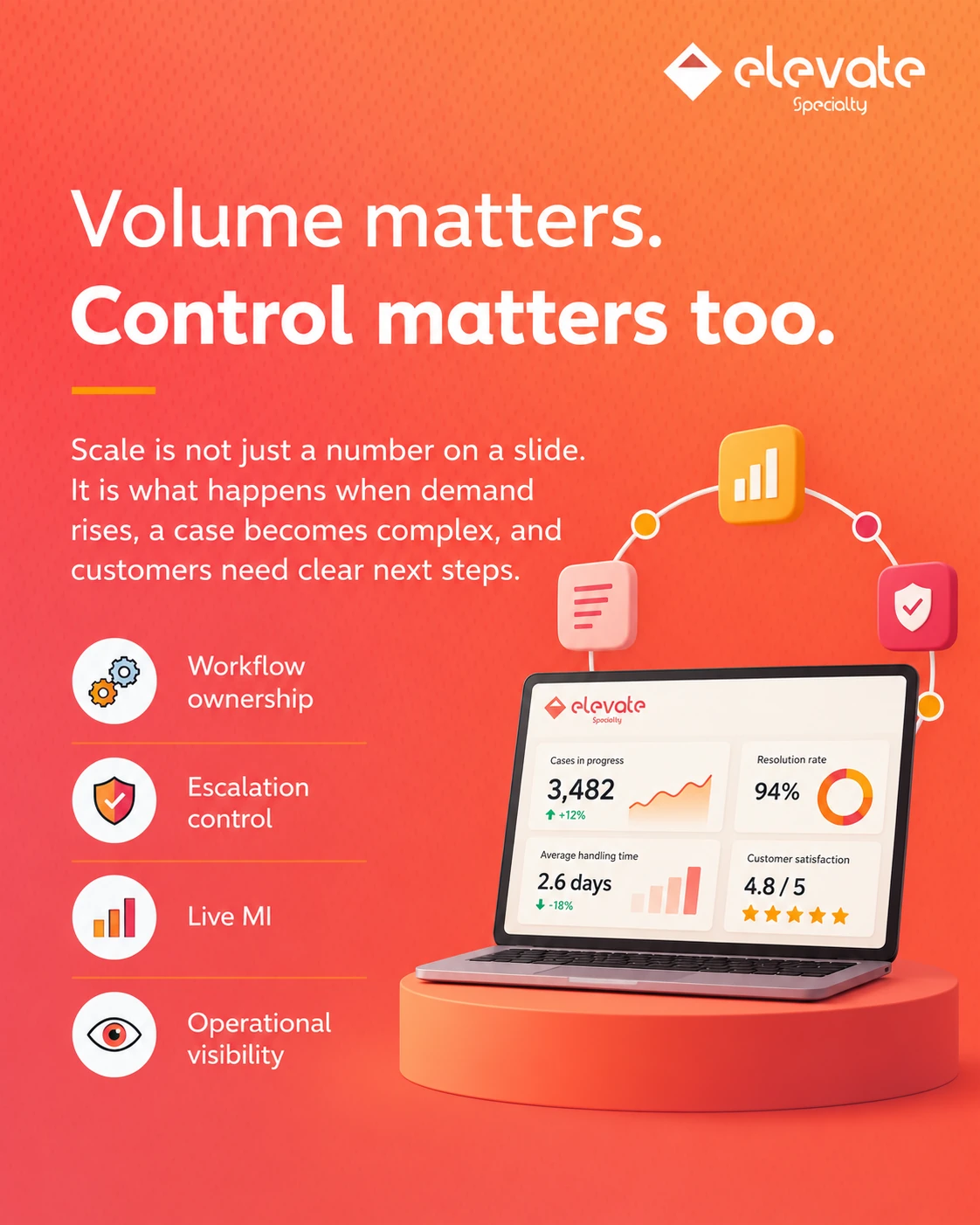
“How much business can you handle?” is a fair question to ask an insurance provider.
The answer should include volumes. It should also explain what happens when those volumes arrive.
How quickly does a customer receive useful help? Who owns an open case? Which tasks are overdue? What happens when a matter becomes urgent or unusually complex? When does management intervene?
A large number on a presentation cannot answer those questions on its own. Nor can a small team’s commitment to work harder indefinitely.
At Elevate, our approach is to connect growth with the controls, resources and information needed to deliver the service behind it.
Plan for the workload, not just the notification count.
Two programmes with the same number of notifications can create very different demands.
One may involve relatively short advice interactions. Another may require evidence gathering, repeated contact, Active Assistance, negotiation and specialist legal work over a longer period. The number of open cases and the complexity of their next actions matter alongside the number arriving.
Our capacity-planning approach therefore starts with notifications, open cases, advice calls and assistance hours. It then considers the effect of complexity, demand surges, staff absence and legal-provider availability.
Resources need to include more than handlers. Technical support, supervision, specialist expertise and agreed overflow arrangements all form part of the service.
The question is not simply whether a provider can accept more work. It is whether the work can be progressed properly.
Make the next action visible.
Control begins at case level.
The service architecture behind Elevate Claims Cloud is designed around one case record that connects customer and policy information with the issue, key dates, evidence, support needs, advice and consent.
It also connects that context to the work completed, current owner, next action, cost, status and result. Role-appropriate access and interfaces are agreed so customers, handlers, partners and underwriting teams receive the information relevant to their responsibilities.
This is not a claim that every participant should see every piece of information. It is a design principle: the people responsible for moving the case forward should be working from the context they need.
A status label alone is not enough. “In progress” should have an identifiable meaning: a person, an action and a reason for what happens next.
Build escalation into the service.
The straightforward case is only one test of an operating model.
What happens when a customer cannot supply the expected document? When the initial route is unsuitable? When urgent legal attention is required? When the specialist provider needs further instructions?
A controlled service recognises exceptions and directs them to the right people. It should not depend on a customer repeatedly chasing until someone notices that the standard process has stopped working.
Our journey design keeps human assessment central to the legal route. Urgent matters go to the appropriate specialist, and routine assistance must not hold up necessary legal action.
The same principle applies to workload. Queues, case ageing and service measures should act as triggers for management decisions. They are not simply figures to explain at the next monthly meeting.
Distinguish activity from an outcome.
A closed case does not, on its own, show that the customer’s problem was resolved. An automated acknowledgement does not establish that useful help was provided. A referral does not demonstrate that the receiving team has acted.
That is why our reporting model connects activity with the result the customer came for.
Was advice or assistance actually delivered? Did the agreed intervention work? Why did the case move to formal legal action? What was the resulting outcome? Was the service clear and accessible to the customer?
These questions help partners examine performance beyond throughput. They also help underwriting teams understand which issues escalate, what drives costs and where changes to the service may be appropriate.
A useful report should lead to a decision: understand the exception, identify the cause, assign an action and check whether it helped.
Test continuity as well as capacity.
An operation also needs to function when circumstances are less convenient.
Policy continuity, case continuity, operational recovery and change control require connected plans. Outstanding claims need appropriate treatment. Cases need complete records and clear ownership. Critical services need recovery arrangements, escalation and urgent-case workarounds.
For a new programme, our approach is to validate people, supplier capacity and recovery arrangements before go-live. A plan to add resources later is different from having the relevant arrangements agreed and ready.
The same honesty should apply to scale claims. Actual volumes handled, capacity tested and future capacity planned are three different forms of information. Partners should know which they are being shown.
The standard is controlled delivery.
Scale matters because partners need confidence that a proposition can support their business. Control matters because every unit of volume represents work that still has to be done properly.
We do not see those as competing priorities. The operating model should connect them.
That is the conversation we welcome at Elevate: not only how much business a programme may generate, but how the service will respond, how the partner will see performance and how decisions will be made when something changes.